



- 15/09/2026
- Author
- Dr. Akshay Wachasundar?
Introduction
Hearing is an essential part of communication, learning, education, professional life
and social interaction. When hearing loss becomes significant, finding the right ENT
specialist and understanding the available treatment options can make an important
difference to patients and their families.
For people searching for an ENT Specialist in Pune, ENT Specialist in PCMC, Cochlear
Implant Surgeon in Pune, or specialised Hearing Loss Treatment in Pune, Dr. Akshay
Wachasundar provides ENT and cochlear implant care for appropriately evaluated
children and adults.
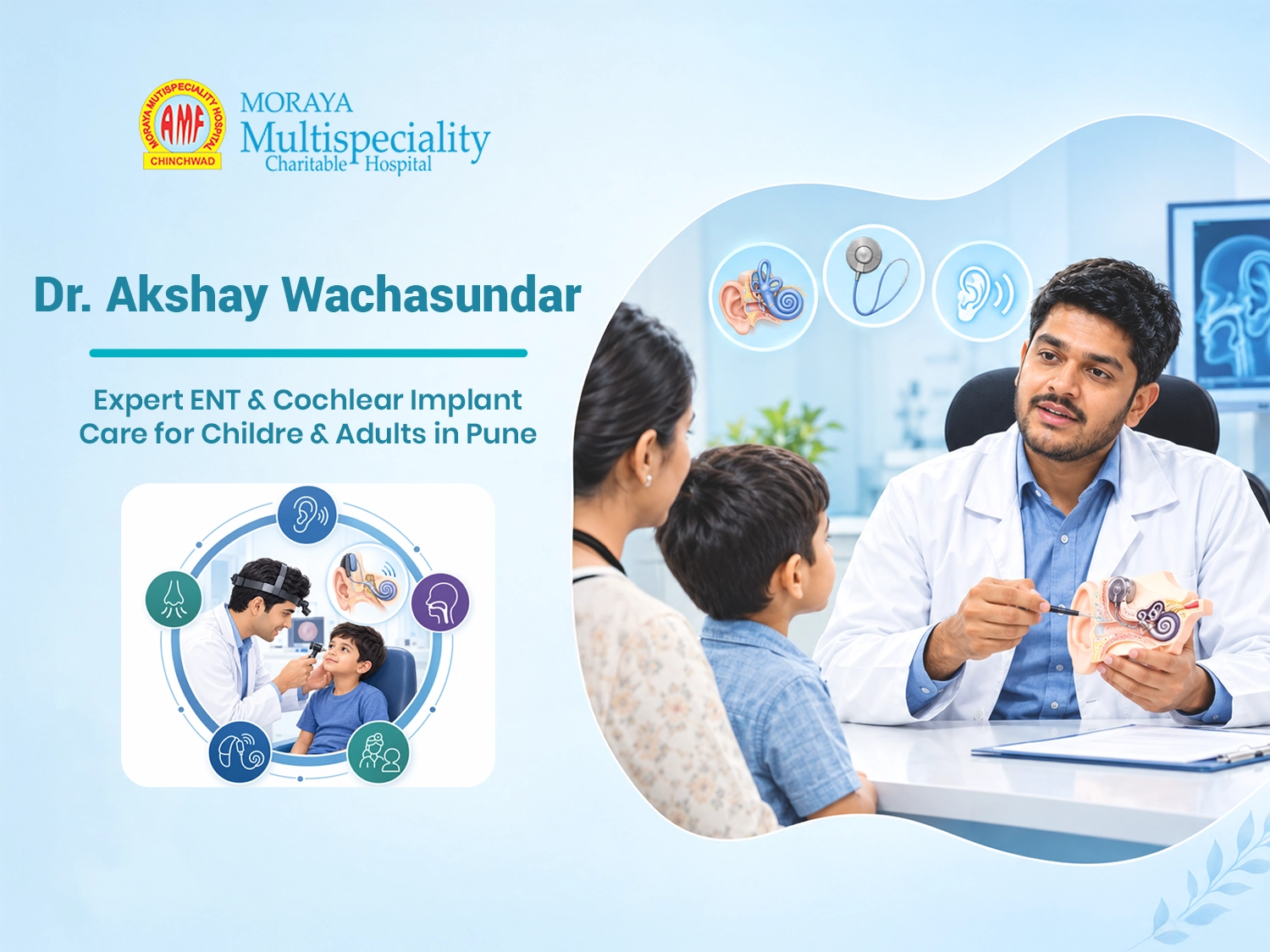
Dr. Akshay Wachasundar is a Consultant ENT & Cochlear Implant Surgeon associated
with Dr. Wachasundar ENT Clinic, Pune and Moraya Multispeciality Hospital,
Chinchwad. His practice focuses on specialist evaluation and treatment planning for
hearing-related conditions and cochlear implantation.
Who Is Dr. Akshay Wachasundar?
Dr. Akshay Wachasundar is a Consultant ENT & Cochlear Implant Surgeon in Pune, providing specialised care for patients with ear and hearing-related conditions. His cochlear implant practice covers the complete treatment pathway, from initial ENT consultation and hearing assessment to candidacy evaluation, surgical planning, cochlear implant surgery and post-operative follow-up. He is associated with:
- ✔ Dr. Wachasundar ENT Clinic, Pune
- ✔ Moraya Multispeciality Hospital, Chinchwad
ENT and Cochlear Implant Care for Children and Adults
Hearing problems can affect people at different stages of life, and treatment
requirements can vary considerably between children and adults.
For children, hearing is closely connected with speech, language, learning and
development. Early identification and appropriate intervention may therefore be
particularly important.
Adults with hearing loss may experience difficulty communicating at home, at work,
over the telephone or in noisy environments.
Dr. Akshay Wachasundar's specialist care focuses on evaluating each patient's
hearing condition and determining an appropriate treatment pathway rather than
applying the same approach to every patient.
Cochlear Implant Care for Children
Children with severe to profound sensorineural hearing loss may be considered for
cochlear implantation when they meet appropriate clinical and audiological
criteria.
Before recommending treatment, the child's hearing history and overall development
need to be carefully assessed.
A paediatric cochlear implant evaluation may include:
- ✔ Detailed hearing assessment
- ✔ Audiological evaluation
- ✔ Hearing-aid benefit assessment
- ✔ Speech and language assessment
- ✔ ENT examination
- ✔ Medical evaluation
- ✔ Imaging when required
- ✔ Assessment of cochlear implant candidacy
- ✔ Parent counselling
Early identification of significant hearing loss can help families explore appropriate intervention options sooner.
Why Early Hearing Care Matters
Children learn to communicate partly through access to sound. When significant
hearing loss is identified, timely intervention can help parents and specialists
develop an appropriate hearing and communication plan.
Depending on the child's condition, treatment may involve hearing aids, medical or
surgical treatment, auditory rehabilitation or cochlear implant evaluation.
A cochlear implant is not automatically recommended for every child with hearing
loss. Candidacy is determined after detailed assessment.
Cochlear Implant Care for Adults
Adults with severe hearing loss may have difficulty understanding conversations, participating in meetings, communicating in noisy environments or using telephones. For selected adults with severe to profound sensorineural hearing loss who receive limited benefit from appropriately fitted hearing aids, cochlear implant evaluation may be considered. The assessment can include:
- ✔ Hearing tests
- ✔ Speech perception assessment
- ✔ Hearing-aid benefit evaluation
- ✔ ENT examination
- ✔ Medical assessment
- ✔ Imaging when required
- ✔ Discussion of treatment expectations
- ✔ Rehabilitation planning
The objective is to understand the patient's hearing needs and determine whether cochlear implantation or another hearing-management option may be appropriate.
What Is a Cochlear Implant?
A cochlear implant is an electronic hearing device designed for selected people with
severe to profound sensorineural hearing loss.
Unlike a conventional hearing aid, which primarily amplifies sound, a cochlear
implant converts sound into electrical signals that stimulate the auditory nerve.
A cochlear implant generally includes an external sound processor and an internal
component that is surgically placed.
The aim is to provide access to sound for appropriately selected patients. However,
a cochlear implant does not guarantee normal hearing, and outcomes can vary between
individuals.
Who May Need a Cochlear Implant Evaluation?
A cochlear implant assessment may be considered for patients who have:
- ✔ Severe to profound sensorineural hearing loss
- ✔ Limited benefit from appropriately fitted hearing aids
- ✔ Difficulty understanding speech
- ✔ Significant communication difficulties
- ✔ Hearing loss affecting education, work or daily activities
For children, additional considerations may include age, duration of hearing loss, hearing history, speech and language development and access to appropriate rehabilitation. A detailed evaluation is essential before making a treatment decision.
The Cochlear Implant Treatment Journey
Cochlear implant treatment involves several stages rather than just the surgical
procedure.
1. ENT Consultation
The process begins with an ENT consultation. The specialist reviews the patient's
hearing history, symptoms, previous treatment and current communication
difficulties.
2. Comprehensive Hearing Assessment
Audiological testing helps determine the type and severity of hearing loss and the
amount of benefit obtained from hearing aids.
3. Medical and Imaging Evaluation
Depending on the individual case, medical investigations and imaging may be
recommended to assess the anatomy of the ear and cochlear.
4. Candidacy Evaluation
The available test results are reviewed to determine whether cochlear implantation
may be appropriate.
5. Treatment Planning
If implantation is considered suitable, the patient and family can discuss the
procedure, implant options, expected stages of care and rehabilitation requirements.
6. Cochlear Implant Surgery
When surgery is recommended, the internal implant is placed surgically and the
electrode array is positioned within the cochlea.
7. Activation and Programming
After an appropriate healing period, the external sound processor is activated and
programmed.
8. Rehabilitation and Follow-Up
Regular audiological follow-up, programming and auditory rehabilitation can be
important for adapting to the implant and making effective use of the device.
Why Comprehensive ENT Evaluation Is Important
Hearing loss can have many causes. Some conditions may respond to medical or surgical
treatment, while others may require hearing aids or cochlear implant evaluation.
A comprehensive ENT assessment helps determine:
- ✔ The type of hearing loss
- ✔ The severity of hearing loss
- ✔ Whether the hearing loss affects one or both ears
- ✔ The possible underlying cause
- ✔ The benefit obtained from hearing aids
- ✔ Whether further investigations are required
- ✔ Whether cochlear implantation may be appropriate
This makes specialist evaluation an important first step before choosing a treatment.
Hearing Loss Treatment in Pune and PCMC
Patients searching for Hearing Loss Treatment in Pune often look for specialist ENT
care that is accessible and provides appropriate diagnostic and treatment support.
For patients in Chinchwad, Pimpri, Wakad, Akurdi, Nigdi, Ravet and nearby areas,
Moraya Multispeciality Hospital in Chinchwad provides access to specialist ENT and
cochlear implant consultation.
The hospital's cochlear implant services include evaluation, hearing assessment,
treatment planning, surgical care and follow-up support.
Why Consider Dr. Akshay Wachasundar for Cochlear Implant Care?
When choosing a Cochlear Implant Surgeon in Pune, patients and families should
consider the complete treatment pathway rather than focusing only on the surgery.
Important factors include:
Specialist ENT Expertise
Cochlear implant treatment requires specialised knowledge of the ear, hearing system
and relevant surgical anatomy.
Comprehensive Evaluation
Appropriate hearing, audiological and medical assessment helps determine whether
cochlear implantation is suitable.
Individualised Treatment Planning
Children and adults can have very different hearing histories and treatment
requirements. A personalised approach is therefore important.
Surgical Planning
Appropriate pre-operative assessment and surgical planning are important parts of
cochlear implant care.
Post-Operative Support
Cochlear implant treatment continues after surgery through activation, programming,
rehabilitation and follow-up.
Family Counselling
For children especially, parents need clear information about the treatment process,
rehabilitation and realistic expectations.
These are among the factors patients should consider when looking for a Cochlear
Implant Surgeon in Pune.
Rehabilitation After Cochlear Implant Surgery
One of the most important aspects of cochlear implant care is understanding that surgery is only one stage of treatment. After activation, the brain needs time to adapt to the new auditory signals. Depending on the patient's needs, rehabilitation can include:
- ✔ Audiology follow-up
- ✔ Device programming or mapping
- ✔ Hearing assessments
- ✔ Auditory training
- ✔ Listening exercises
- ✔ Speech and language support
- ✔ Regular monitoring
The rehabilitation process differs between individuals. Age, duration of hearing loss, previous hearing experience and consistent device use can all influence the overall journey.
When Should You Consult an ENT Specialist?
Consider an ENT evaluation if you or your child experiences persistent hearing-related concerns such as:
- ✔ Difficulty hearing conversations
- ✔ Frequently asking others to repeat themselves
- ✔ Delayed speech development
- ✔ Poor response to sounds
- ✔ Recurrent ear problems
- ✔ Difficulty understanding speech in noisy environments
- ✔ Significant or progressive hearing loss
- ✔ Limited benefit from hearing aids
- ✔ Hearing difficulties affecting school, work or daily activities
Early evaluation can help identify the underlying problem and determine what treatment options may be appropriate.
Supporting Families Through the Hearing-Care Journey
A diagnosis of significant hearing loss can be challenging for families, particularly
when it involves a child.
Parents may have questions about hearing aids, cochlear implants, surgery,
rehabilitation, speech development and long-term expectations.
A specialist consultation should provide an opportunity to understand the diagnosis
and available options clearly. Families can then make treatment decisions based on
their child's or family member's individual hearing needs.
Conclusion
Choosing the right specialist is an important step when dealing with hearing loss or
considering cochlear implantation. Children and adults can have very different
hearing needs, making individualised evaluation and treatment planning essential.
Dr. Akshay Wachasundar, Consultant ENT & Cochlear Implant Surgeon in Pune, provides
specialised ENT and cochlear implant care through Dr. Wachasundar ENT Clinic, Pune,
and his association with Moraya Multispeciality Hospital, Chinchwad.
For patients and families searching for ENT Specialist in Pune, ENT Specialist in
PCMC, Cochlear Implant Surgeon in Pune, Hearing Loss Treatment in Pune or cochlear
implant care for children and adults, specialist evaluation can be the first step
towards understanding the most appropriate treatment options.
Consult Dr. Akshay Wachasundar for specialist ENT and cochlear implant evaluation at
Moraya Multispeciality Hospital, Chinchwad.